Saving diesel
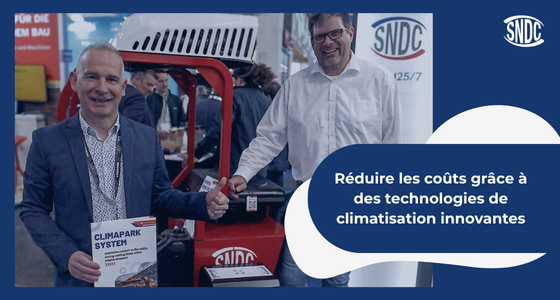
“Climapark” bypasses the compressor when the engine is switched off using an electrically driven compressor that draws its power from the vehicle’s battery. This saves diesel and protects the environment. At its core, this is all about state-of-the-art air-conditioning technology for commercial vehicles:
“Our ‘SKIMO’ and ‘SKIMO Split’ air-conditioning systems have been available since 2010,” explains David Massat. Both product ranges were developed for vehicles with 100 per cent electric drive or with internal combustion engines that have no space in the cab or engine compartment. For over 35 years, SNDC, based in Labarthe-sur-Lèze near Toulouse in France, has been developing and manufacturing air conditioning, heating, ventilation, air filtration and pressurisation systems, as well as accessories for the original equipment manufacturer (OEM) and aftermarket sectors, for a wide variety of passenger compartments and cab types across numerous industries. Customers come from the construction, aviation, forestry, military, mining, airport vehicles, passenger transport, and heavy goods, industrial and specialised vehicle sectors.
Hauser Umwelt-Service is an SNDC partner in Germany. Based in Dorsten, the company offers the ‘CoRRect air K71’, a retrofit air-conditioning system for construction machinery. In addition, the ‘CoRRect air K71e SKIMO roof’ is a compact electric air-conditioning solution suitable for almost all voltage ranges of electric industrial trucks and construction machinery.
Compact and versatile
The ‘CoRRect air K71e-SKIMO split’ combines the advantages of an electric air-conditioning system with the numerous integration options of a split system. The split version combines the compressor and condenser in a compact external housing. This can be mounted either flat or horizontally on the outside of the vehicle. Only the evaporator and the air distribution system are installed in the cab. “These systems are used in electric vehicles such as forklift trucks, industrial trucks, tow trucks and cranes,” explains Carsten Planker, Managing Director of Hauser. The construction, transport and logistics sectors, as well as the agricultural sector, offer the most opportunities for their use.
In-cab comfort
According to the company, the ‘Climapark’ system – which builds on the classic air-conditioning system – marks the start of a new chapter. ‘It really is something of a revolution,’ says David Massat, describing the new product, which operates independently of the main engine and is the result of intensive research. What is it all about? Air-conditioning systems require energy, which is usually supplied by the vehicle’s diesel engine – even when, for example, wheel loaders or excavators are not actually in operation. If the engine is switched off, the heating and air-conditioning systems also stop working. Conditions for drivers in the cab can then quickly become unbearable. Wheel loaders and excavators often spend more than 40 per cent of their operating time idling. This wastes valuable fuel and pollutes the environment with unnecessary CO₂ emissions. Furthermore, the frequent idling significantly shortens the vehicles’ maintenance intervals. According to the manufacturer, the ‘Climapark’ system now puts an end to this. ‘The machines no longer need to be running when the air conditioning is switched on,’ explains David Massat. The secret: when the engine is switched off, ‘Climapark’ bypasses the compressor using an electrically driven compressor that draws its energy from the vehicle’s battery. This saves diesel and protects the environment. According to Hauser, a sample calculation illustrates the benefits: with 120 operating hours per month and the air conditioning running for 35 per cent of the time whilst the vehicle is idling, and assuming a consumption of 6.51 litres of diesel whilst idling, 2,741 litres of diesel are saved each month and the maintenance cycle is extended by a full 2.2 months. Important for the environment: at the same time, 723 kg less CO₂ is emitted into the atmosphere.
Translated from the attached article: Mit innovativer Klimatechnik die Kosten senken